CinePixo
ReviewsOff CameraMoviesPeopleTopicsCriticsStats
Sign inJoin
ReviewsOff CameraMoviesPeopleTopicsCriticsStats
CinePixo
ReviewsOff CameraMoviesWatchCriticsWritersStatsAboutEditorial StandardsContactPrivacyTermsRSS

CinePixo — a home for film-critic fandom.Built, filled and argued over by this community — the library, the artwork we license and host, the taxonomy and every signed review grow here, together.

  1. Home
  2. /Off Camera
  3. /The Argument
  4. /The Grammys Built a Separate Room for Asian Pop. Film Ran That Experiment for 70 Years.
The ArgumentEditorial feature

The Grammys Built a Separate Room for Asian Pop. Film Ran That Experiment for 70 Years.

BTS changed a lyric at MetLife Stadium to refuse a category invented for them. The argument they are having with the Recording Academy is the one the Oscars had — and cinema's results are already on the record.

by CinePixoAugust 22, 20264 min read31 views
Bong Joon-ho
Bong Joon-ho · Kevin Paul (CC BY 4.0)

In this piece

  1. 01A lyric became a position
  2. 02The category nobody asked to be put in
  3. 03Film has already run this experiment
  4. 04What the record actually shows
  5. 05While that argues itself out

A lyric became a position

On 1 and 2 August, BTS played MetLife Stadium in New Jersey on their ARIRANG world tour. According to their agency, BigHit Music, the two nights were sold out and drew roughly 157,000 people — figures reported by the Korean outlet Edaily, which covered the shows.

Somewhere in "MIC Drop," RM stopped singing the recorded lyric. What he sang instead, per Edaily's account, translates roughly as: the people talking will keep talking, and we will keep going our own way — we were born in Korea, so they don't really know us.

That is not a throwaway. The Recording Academy has created a new Asian Pop category, and BTS have said they will not submit to it. Their stated reason, again as reported: music should be judged and loved as work, not by its region or its language. Fans in the stands went further, unfurling slogans reading that BTS built unity and the Grammys built division.

Song Kang-ho

Photo: Ministry of Information and Broadcasting · GODL-India · source

The category nobody asked to be put in

A new award looks like an addition. It is also a boundary, and boundaries have two sides.

The pitch for a category like this is always the same, and it is not made in bad faith: without a dedicated slot, work in a non-English language gets crowded out by the machinery of the mainstream categories, and a nomination somewhere beats a nomination nowhere. That argument has real weight when a form is genuinely locked out.

The counter-argument is that a dedicated slot becomes the ceiling rather than the floor. Once there is a correct room for your work, being considered in the general categories starts to look like a category error — and voters, who are busy, take the hint.
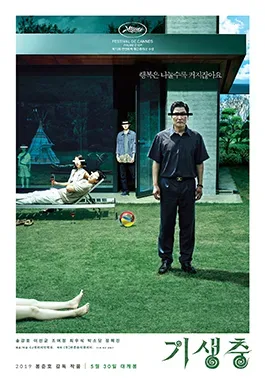
Parasite (2019)

Photo: © the film's rights holders · Poster shown for identification · source

Everything Everywhere All at Once (2022)

How this piece was made

Editorial standards →

Editorial feature

A CinePixo feature whose more specific reporting or utility method has not been claimed.

In this piece

  • Bong Joon-ho
    Bong Joon-hofilm director
  • Song Kang-ho
    Song Kang-hoactor
  • Parasite posterParasite

In this piece

  1. 01A lyric became a position
  2. 02The category nobody asked to be put in
  3. 03Film has already run this experiment
  4. 04What the record actually shows
  5. 05While that argues itself out

Photo: © the film's rights holders · Poster shown for identification · source

Film has already run this experiment

This is the part of the story that belongs on a film site, because cinema did not theorise about this. It ran the test for decades and published the results.

The Academy Awards have honoured non-English-language film in a separate category since the 1950s, under a name — Best Foreign Language Film — that stated the premise plainly. The work was foreign. The main categories were, by implication, not for it. For most of that history, a film could win the separate award and simply never appear on the Best Picture ballot.

Then, in January 2020, Bong Joon-ho accepted the Golden Globe for that category and said the thing that has been quoted ever since: once you get over the one-inch-tall barrier of subtitles, a great many more films become available to you. He was describing the barrier as small. The size was the argument.

A month later, Parasite won Best Picture — the first film not in English to do so — on the same night it won the renamed Best International Feature. Both awards, one film, one evening. The separate room had not been abolished; it had been shown not to be a ceiling.

Three years after that, Everything Everywhere All at Once swept the general categories with no separate room involved at all.

What the record actually shows

It is worth being careful about what that history proves, because the triumphant version of it is not quite true.

Best International Feature still exists. Films still get filed into it. What changed was not the architecture but the assumption behind it: that filing was a destination. The Academy did not tear the room down. Voters stopped treating it as the only door.

Which suggests the argument BTS are making is narrower and more interesting than "no new categories." A category is not automatically an insult. It becomes one when it functions as an alibi — when the existence of the correct slot is the reason nobody had to consider the work anywhere else. That is a claim about behaviour, not about structure, and it is testable in exactly the way film's version was: watch what happens in the general categories over the next few years.

While that argues itself out

Two films on this site are the readable version of the whole dispute. Parasite is the one that proved the barrier was an inch. Everything Everywhere All at Once is the one that behaved as though the barrier had never been mentioned. Neither needed a room of its own.

Edaily also notes that "ALIENS," a BTS track about the line drawn between outsider and mainstream, has been climbing the charts again in the weeks since the Grammy story broke. Four months after release, a song about being looked at from outside is finding a second audience. Sometimes the argument makes its own soundtrack.

2019 · Bong Joon-ho
  • Everything Everywhere All at Once posterEverything Everywhere All at Once2022 · Daniel Kwan, Daniel Scheinert
  • Sources

    1. 01m.entertain.naver.com · https://m.entertain.naver.com/music/article/018/0006345072

    Every factual claim above is drawn from these. The reading of them is ours.

    grammy asian pop categorybts grammysbong joon-ho one inch barrierbest international featureawards category segregationparasite best picture

    4 min read

    ShareXFacebookThreads
    C
    CinePixo

    Founder of CinePixo — a home for film-critic fandom.

    Full profile and all work →

    More The Argument

    All of it →
    The Argument

    Werner Herzog Says AI Filmmakers Should Fail—Then Explains Why

    Werner Herzog has dismissed the AI-generated documentary About a Hero as “phenomenally, abysmally stupid.” His broader argument is harsher: machines can replace formula, but formula is exactly what has hollowed out too much filmmaking.

    Dorothy Kwan·Sep 13, 2026

    The Argument

    Tilly Norwood’s CNN Interview Exposes the Limits of AI Acting

    Hollywood’s first AI actor says she is “not the enemy,” then stalls when CNN asks her to perform without a prompt. The exchange makes the sales pitch around Particle6’s film Misaligned look less like a revolution than a production workflow with a face.

    Dorothy Kwan·Sep 10, 2026

    The Argument

    Danny Boyle’s ‘Ink’ Uses AI for 30 Seconds—and Owns the Choice

    Danny Boyle confirmed at Telluride that generative AI appears in roughly 30 seconds of ‘Ink,’ including animated archival photographs and newsroom mice. The film reaches U.S. cinemas in December before its Netflix debut in January 2027.

    Dorothy Kwan·Sep 9, 2026

    The Argument

    Gal Gadot Backs AI ‘Bitcoin’ and Nears a Wonder Woman Exit

    Gadot says actors must work with AI or leave the game, though she spent six months shielding her own performance from it. She also says another Wonder Woman film no longer fits her life.

    Dorothy Kwan·Sep 7, 2026