
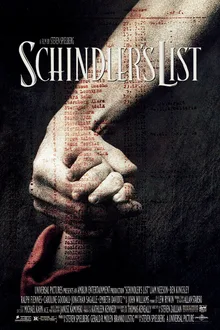
The Ghetto Sequence Is the Achievement. The Violin Is the Retreat
Spielberg gives away his authority over the frame for long stretches of this film, and those stretches are the most formally rigorous work of his career; what surrounds them cannot bear to leave a viewer alone with what has been photographed.
The verdict
Kamiński's handheld camera makes attention a moral act, and then the score and one tinted coat step in to make the decision for the audience it had just trusted.
The camera is a witness, and it is not a steady one
Janusz Kamiński shot this film in black and white, on 35mm, with the camera in someone's hands for much of its length. That decision is the film's argument, and it is made before a word is spoken. A tripod composes. A held camera attends. When the frame shifts slightly because an operator's weight moved, the image admits that a person is present, watching, and could have looked elsewhere.
Spielberg is not usually a director who admits that. His reputation rests on the opposite gift — the ability to place a camera exactly where the emotion is and hold it there until the audience arrives. Here he gives much of that authority away. In the liquidation of the Kraków ghetto, the film stops organising. It follows one figure, loses them, picks up another, hears something off-screen and turns too late. Events happen at the edges. Deep focus keeps the background populated, so a viewer is never permitted the mercy of a shallow plane where only the foreground exists.
This is the most rigorous stretch of filmmaking in Spielberg's work. It respects the ambiguity of a real space by refusing to master it. A sequence that long, that unorganised, that willing to let the viewer's attention fail is a formal achievement, and it is the reason to take the film seriously as cinema rather than as an occasion.
Deep focus, and a window that will not close
The film is full of frames inside frames — doorways, windows, the slats of a cattle car, the gap between a curtain and a sill. Kamiński repeatedly shoots from inside one room into another, so that an event has a foreground of people who can see it and choose what to do. Oskar Schindler watches through glass a great deal. So does Amon Göth, from a balcony above the camp, and the film gives that balcony the same visual grammar it gives Schindler's window.
That parallel is the film's finest piece of construction and it is achieved by staging rather than by cutting. Two men look down through an opening at people who cannot look back. The composition makes the moral distinction sit inside a physical resemblance, and it does so without a line of dialogue nominating it. Ralph Fiennes plays Göth in full body, in wide shots, doing ordinary things at ordinary speed. Nothing about the framing marks him as an aberration. The film understands that a monster who is photographed like a monster has been let off.
Liam Neeson is used the same way — kept at a distance, in his whole physical bulk, so that the performance is carried by posture and by the way a man occupies a room he has bought his way into. Ben Kingsley works in the opposite register, contained and precise, and the two are frequently in the same frame rather than in alternating close-ups. Coverage would have made their relationship into a series of reactions. Staging makes it a negotiation.