The Zone Refuses to Become Scenery
The journey advances slowly, but the world never stands still. A trolley rattles, water carries debris, wind crosses grass, and three men discover that attention is harder than belief.
The verdict
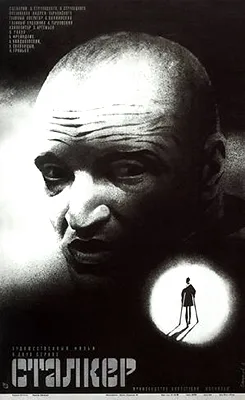
Stalker makes duration an ethical form: the Zone is never reduced to an obstacle course because Tarkovsky lets water, grass, rust and human doubt continue existing beyond the travelers' explanations.
Crossing is a change in attention
The journey into the Zone begins on a rail trolley. Andrei Tarkovsky holds on the three travelers as the wheels strike a repeating metal rhythm beneath them. The industrial landscape passes without being organized into a sequence of explanatory views. Faces remain in duration. The Stalker, the Writer and the Professor are carried forward together, each isolated by the way he looks and listens. Arrival is not announced by spectacle. The image changes, but the deeper crossing has already occurred: the film has trained the viewer to wait without demanding that waiting be converted into information.
Outside the Zone, walls, bars and machinery press the world into a worn monochrome. Inside, color does not make nature innocent. Green growth covers ruins; water passes over syringes, coins, metal and fragments whose histories are unavailable. The place is neither wilderness nor set. It is an environment continuing after human purposes have failed. Tarkovsky's camera moves through it slowly enough that objects keep their opacity. A submerged object may invite interpretation, but the shot does not certify one.
The Stalker leads his companions by throwing weighted strips of cloth to test a route. He insists that the direct path is unsafe even when the destination appears close. The rule could be fantasy, ritual, fear or knowledge. Tarkovsky does not cut to proof. Space remains ambiguous because the men must act before certainty arrives. The camera respects that condition. It watches them choose.
A room approached through detours
At the center of the journey is a Room said to grant a person's deepest desire. A conventional science-fiction film would make the Room the answer and arrange the route as a rising series of hazards. Stalker makes the route an erosion of the question. The Writer's contempt, the Professor's guarded purpose and the Stalker's faith do not develop through revelations supplied by the Zone. They become visible through fatigue, delay and proximity. Men who could maintain positions over a table cannot preserve them while lying in wet grass.
Aleksandr Kaidanovsky gives the Stalker a body shaped by vigilance. He crouches, listens and presses himself close to the ground, not as a conqueror reading signs but as a guest afraid of violating a host's rules. Anatoly Solonitsyn's Writer fills space with speech, testing whether irony can keep disappointment from reaching him. Nikolai Grinko's Professor carries equipment and reserve with the gravity of a man who prefers an instrument to a confession. Their differences are spatial before they are philosophical: one touches the earth, one prowls and provokes, one measures.
Long takes do not make the film neutral. Duration is a decision, and Tarkovsky uses it rigorously. A shot that continues after narrative information has been delivered allows weather, posture and sound to resist the men's claims. When the camera glides over water, the objects below do not become illustrations of memory or civilization. They remain present, altered by submersion and current. The world exceeds the argument being conducted across it.