
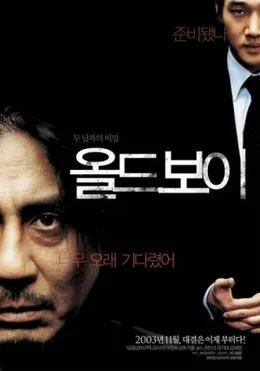
The Corridor Is the Whole Argument
Everyone remembers the hammer. What the corridor scene is actually made of is time — a single take that refuses to cut because its hero was refused fifteen years of cuts.
The verdict
Park builds a revenge film out of duration itself — one hallway, one take, and fifteen years that never leave the frame.
Fifteen years in a room, and the film shows you the room until you stop asking why. That is the wager Oldboy makes in its first act, and it is a formal wager, not a narrative one: Park Chan-wook compresses a decade and a half into a montage of dumplings, television static and a face losing its softness, so that when Oh Dae-su finally walks free, the film has taught you its real subject. Not revenge. Duration.
One take, sideways
The corridor fight is the most quoted scene in the film and the most misquoted in memory. People recall it as action choreography; it is closer to a sentence being served in miniature. The camera tracks laterally, flat against the wall like a frieze, and it does not cut — because a cut is a mercy, an escape from time, and this film's premise is a man who was denied exactly that mercy. So the take runs on. Dae-su swings his hammer, falls, gets up more slowly, swings again, and the scene's rhythm decays in real time the way no cut-assembled fight ever decays. By the end the extras are barely acting and the hero is barely standing, and the shot has made its argument: exhaustion is the truth of violence, and only unbroken time can photograph it.
The flatness matters as much as the length. Shot side-on, the corridor becomes a scroll — critics have compared it to a video game, and the comparison is right for the wrong reason. It is not that the film is playful; it is that the composition removes depth, and with it the fantasy of escape. There is nowhere to go but forward, through.
The cell, the edit
Rewatch the imprisonment sequence and notice how the cutting does the opposite work. Years vanish between shots; a newscast, a haircut, a tally on a wall. Montage is the film's instrument of cruelty here — it can discard fifteen years in four minutes because nobody is counting Dae-su's days but Dae-su. The corridor take and the cell montage are the same idea mirrored: time compressed when the world forgets him, time made indivisible when he fights his way back into it.
Jo Yeong-wook's score holds the film's temperature down. The waltz that carries the late passages is elegant, formal, almost courtly — scored not to the violence but to the design behind it, and the dissonance between what you hear and what you watch is where the film's dread actually lives.
The reveal, left sealed
There is a turn in the last act that this review will not describe. What can be said formally: the film prepares it not with clues but with tone, and when it lands, every earlier scene re-cuts itself in your memory. Few thrillers survive their twist; this one is enlarged by it, because the twist is about the same subject as the corridor — what time, given enough of it, can be engineered to do to a person.
Oldboy