
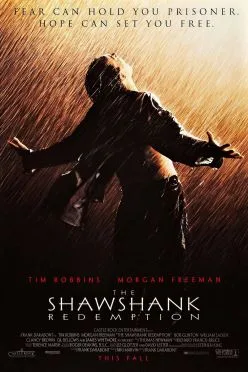
A Prison Picture That Is Really About Company
Two hours and twenty-two minutes at the worst address in Maine, and what stays with me is a rooftop, three beers a man, and somebody watching his friends enjoy themselves.
The verdict
The Shawshank Redemption keeps every promise a prison movie makes and then quietly changes the subject to friendship, which is why people who do not like prison movies love this one.
Minor spoilers ahead
Three Beers on a Roof
There is a scene about a third of the way into The Shawshank Redemption where a work detail is tarring a roof in the sun and Andy Dufresne talks the guard captain into giving the men cold beer. They sit along the parapet drinking it. Andy does not drink. He sits apart with his back against the wall and watches them, and Tim Robbins lets the smallest amount of pleasure onto his face — a man who has just discovered what he is good for in here.
I have watched that scene many times and it still tells me everything about why this movie works on people who normally cannot sit through a prison picture. It is not about escape, or not mainly. It is about the currency men use when they own nothing: a favour, a beer, an hour of feeling like a free man on a roof. Frank Darabont, adapting Stephen King's novella, understood that the audience needs one thing above all — somebody in there to sit with — and gives us two, and then makes us wait twenty years with them.
Morgan Freeman is that second somebody, and I want to be plain about what he does, because "the narrator" undersells it. Red is a fixer, a realist, a man who has decided that hope is a luxury good he cannot afford, and Freeman plays him with the wariness of somebody who has been disappointed on schedule for forty years. He narrates the film, but the narration never explains a feeling to us; it reports facts and lets us do the feeling. His parole hearings, three of them across the picture, are the most economical character writing in any American film of the nineties. Watch what happens to his shoulders between the first and the last.
The Faces, the Rooms, and Brooks
Roger Deakins photographed this, and it looks like the inside of an institution rather than the idea of one — most of it shot in a real closed reformatory in Ohio, all sweating stone and iron balconies stacked five tiers high, the light always coming from too far away. Thomas Newman's score never gets ahead of the story. Bob Gunton's warden is one of the great screen hypocrites, a man who keeps the Bible in one hand and something worse in the other, and Clancy Brown plays the captain as pure casual municipal violence, the kind that goes home at five.
But the performance that opens the movie's real subject belongs to James Whitmore. Brooks Hatlen has been inside fifty years, he runs the library, he keeps a bird, and what happens to him when the state finally lets him go is the saddest ten minutes in the film and the reason the film is not sentimental. Red gives the diagnosis in one word — institutionalized — and Whitmore has already acted it before the word arrives. Any movie can show you that prison is cruel. This one shows you that it becomes home, which is worse, and it does it with an old man alone in a rented room trying to remember how doors work.
There is a scene where Andy locks himself in an office and puts a record on the public address system, and two women's voices in Italian go out over the yard while a couple of hundred men stand still in the dirt. I am not going to pretend to be above that scene. It is a big, unembarrassed, movie-sized gesture about what beauty is for, and it is earned because the film has spent an hour showing us exactly how little else these men are given.