
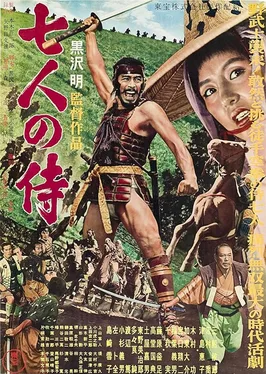
A Village Worth Three and a Half Hours
Kurosawa gives us strategy, mud, jokes, fear and seven distinct men, but the great achievement is simpler: by the time the rain comes, every patch of ground has somebody's life attached to it.
The verdict
Seven Samurai earns its epic length one face and one practical decision at a time, until defending a village feels less like legend than the exhausting work of learning to belong to other people.
First, find seven people willing to help
A poor farming village learns that bandits will return after the harvest. The villagers have almost nothing to offer except food, so they go looking for hungry samurai. That is the premise of Seven Samurai, and Akira Kurosawa spends the first stretch of his long movie treating recruitment as drama rather than paperwork. I love him for it. Before the battle plan, before the horses and rain, somebody has to look at a frightened stranger and decide whether he can be trusted.
Takashi Shimura's Kambei enters by solving a crisis with no audience in mind. He cuts off his topknot, borrows a priest's robe and does what the moment requires. The scene tells us nearly everything about him without making him announce a code. He is observant, modest and tired enough to know that heroism is usually a practical problem. When he later studies the village, counting roads and measuring weak points, leadership becomes the same act at a larger scale: pay attention, then accept responsibility for what you have noticed.
The other samurai arrive with different temperatures. Some are seasoned, some proud, some young enough to mistake admiration for experience. Toshiro Mifune's Kikuchiyo barges into the group like a one-man argument. He boasts, drinks, performs outrage and waves a lineage he has not earned. He is also the person most alert to the humiliation of the farmers because he cannot keep his own history from recognizing theirs. Mifune is very funny until, in an instant, he is not. His whole body changes before the dialogue catches up.
The map becomes a community
Kurosawa makes geography emotional. We learn the paths, fields, bridge, houses and treeline as Kambei does. Barricades go up. Homes outside the defensible boundary must be abandoned. Farmers train with bamboo spears. Every tactical choice costs someone something, and the movie gives that cost a face. By the time the bandits approach, suspense does not depend on surprise. We know where danger can enter because we watched people decide where safety had to end.
This is an action film with an extraordinary interest in labor. Rice must be counted. Watches must be assigned. A frightened group has to practice moving together. Kurosawa lets preparation become pleasurable because competence is pleasurable. He also knows that a plan made on dry ground will eventually meet weather, panic and a horse that does not care about the diagram.
The picture is often described as the ancestor of every assemble-the-team movie that followed, which is true and slightly unfair. Descendants borrowed the introductions, specialties and climactic mission. Fewer kept the social friction. The samurai need the farmers and look down on them. The farmers need the samurai and fear them. Old violence sits between the groups before the new violence arrives. Cooperation does not dissolve class; it forces people with unequal power to work in the same mud.