
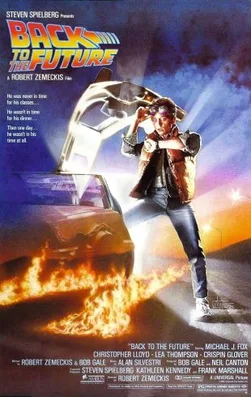
Nobody Warns You That It Is About Your Parents
Zemeckis and Gale built a clockwork so smooth that people praise the clock instead of the picture, and the picture is a genuinely moving story about forgiving two people for having once been young and frightened.
The verdict
The DeLorean gets the poster, but the reason the last act plays like a held breath is that a boy has met his mother and father as teenagers and cannot help liking them.
It is a family drama wearing a very good disguise
I have watched this movie more times than is respectable, and every time I am struck by the same thing: nobody warns you that it is about your parents. You come for the car. You stay because a seventeen-year-old boy has to sit in a diner and look at his father as a seventeen-year-old boy, and find out that the man was a coward before he was a disappointment.
That is a real subject. Robert Zemeckis and Bob Gale built a machine around it so smooth that people talk about the machine instead. Fine — the machine is a marvel. But the reason the last act plays like a held breath is not the plutonium. It is that Marty McFly has met his mother and father as kids and he likes them, which is the last thing he expected and the one thing that could hurt him.
The house tells you everything before anyone speaks
Look at the McFly house in 1985. It is not squalid — it is worse than squalid, it is beaten. The furniture is perfectly adequate. The television is on and nobody is really watching it. Lorraine has a drink and a story she has told before, and Lea Thompson plays her with a kind of glazed sweetness that is the most quietly devastating thing in the movie. Crispin Glover's George laughs at the television at exactly the wrong pitch. In four minutes, without a single line of exposition about the family's history, you know precisely how much life has been surrendered in that room and roughly when.
Then the film takes the same actors, hands them thirty fewer years, and lets you watch them be capable of something. Glover's 1955 George is not a different person; he is the same nervous man before the nervousness set like concrete. Thompson's Lorraine is not a different woman; she is that sweetness with the glaze not yet on. Both performances depend on you having seen the later version first, which is a screenwriting trick of a very high order, and both actors are good enough to make the trick feel like observation.
I keep coming back to Glover's hands. He does something with them — a fold, a retreat — that he does in both time periods, and it is the same gesture at two different pressures. That is an actor thinking.
Michael J. Fox is doing more work than he gets credit for
Fox has to be the audience's representative and the film's engine at once. He is on screen almost continuously and he is almost always reacting to something absurd, which is the fastest way for a performance to go shrill. He never does. He plays each impossibility as a practical problem: right, that happened, now what. When his eyes change — and they change several times, always a beat before the dialogue admits it — you see a kid recalculating what he thought he knew about the two people who raised him.