
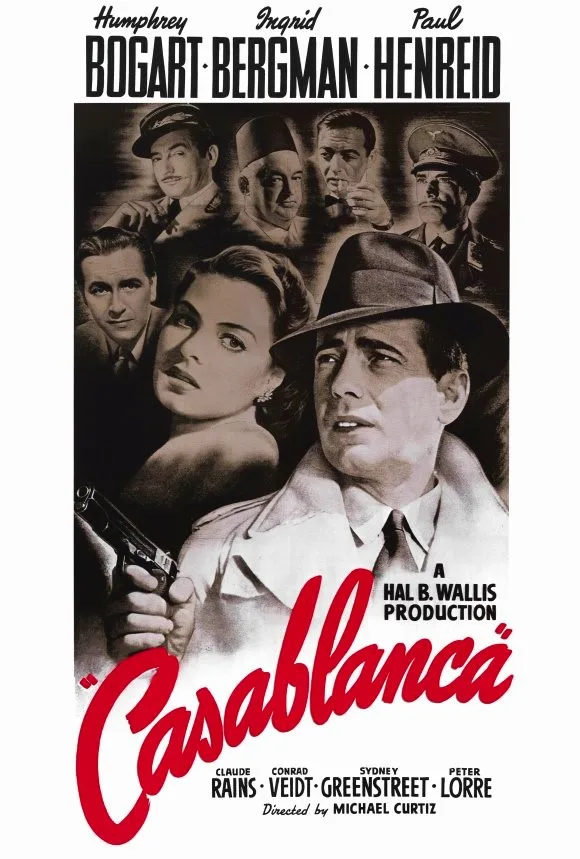
Everybody Comes to Rick's, and Nobody Leaves Unchanged
A hundred and two minutes, one saloon, and about nine performances that would each carry a picture on their own.
The verdict
Casablanca has no business working as well as it does, and it works because everyone in it is playing somebody who wants something and is too proud to say so.
Minor spoilers ahead
The Room Does the Work
I have seen this picture more times than is respectable and I still cannot tell you how it gets away with it. On paper it should not. It was shot on a schedule, on a backlot, from a script that was being rewritten while the cameras rolled, and the people making it did not know how it ended until close to the end. What comes out is a film so sure of itself that generations of us have quoted it to each other in bars.
Here is what I think does it: the room. Almost everything happens in Rick's Café Américain, and Michael Curtiz films that saloon as a place with an economy. There is a floor where the money is, a bar where the truth is, a table where the Germans sit, a piano that everyone in the room is pretending not to listen to, and a locked office upstairs. You learn the geography in about four minutes and after that the film can tell you a great deal simply by where somebody chooses to stand. When Ilsa walks in, she does not have to say anything. She only has to be in the wrong part of the room.
And the faces. Look at what happens in Humphrey Bogart's face when Sam starts playing. Nothing, and then everything, and then nothing again — a man deciding in real time to keep being the man he has told everyone he is. Ingrid Bergman is doing something even harder. She is lit like a saint and playing somebody with two loyalties and no good options, and the camera loves her in a way that would be cheap if she were not so plainly intelligent behind the eyes. She looks like she is calculating. That is the whole performance.
Nine Actors and Not a Weak One
What people forget about Casablanca is how deep the bench is. Claude Rains gets the best lines and delivers them like a man who has decided that corruption is more comfortable than conviction and is not entirely at peace with the arrangement. Peter Lorre is on screen for a few minutes and haunts the rest of the picture. Sydney Greenstreet turns a rival club owner into a philosophy. Conrad Veidt's Strasser is exact and unhurried, which is far more frightening than shouting; and it is worth knowing that a good number of the people playing refugees in that café were refugees, standing in front of a camera in California with the war still going on.
The Marseillaise scene is the one everybody remembers, and I have stopped resisting it. The Germans sing, the room answers, and Curtiz cuts among faces — the guitar player, the young woman who has been selling herself for exit papers, Rains watching and saying nothing. It is a musical number about whether a group of frightened people will risk something together. It works on me every single time and I have given up being embarrassed about that.
The picture is also funnier than its reputation. It is a comedy of graft — everybody in this town is running a small operation, and much of the pleasure is in watching professionals recognise each other. "Round up the usual suspects" is a joke about how the world actually runs.