Bronze, Dust, and the Sound of a Crowd Becoming an Animal
The film’s greatness lies less in its grandeur than in its surfaces: dirt under nails, light on armor, a voice lowered until vengeance sounds like exhaustion.
The verdict
Ridley Scott’s Gladiator is not a perfect epic, but it is a fiercely tactile one, built from weathered metal, wounded faces, and the terrible music of spectacle.
The Weight of the World
Gladiator begins in cold air. Not in marble, not in rhetoric, not in the polished Rome of schoolbook imagination, but in a forest soaked with smoke and mud. The first movement is all breath, fur, ash, steel. Men wait in ranks while the trees seem to exhale winter. Ridley Scott understands empire first as climate. Before Rome becomes architecture, it is a pressure system.
The battle that opens the film has the brutal clarity of a furnace door being opened. Fire arcs through gray air. Horses rupture the frame. Armor is not decorative; it is heavy, scraped, dented, burdensome. The camera does not linger delicately over violence, yet it makes violence felt as impact and interruption. Bodies collide in a churn of brown, black, and orange. The image seems struck rather than composed.
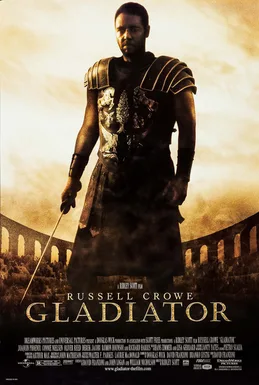
Russell Crowe’s Maximus is introduced through economy. A hand brushes wheat. A face listens before it speaks. Crowe gives the performance its force by withholding flourish. His voice has a dry grain, a firmness that never becomes theatrical. He carries command as a physical condition, like a healed injury. When he speaks to soldiers, there is no perfume of inspiration. The words are clipped, practical, nearly private. His authority is not announced; it settles.
Richard Harris, as Marcus Aurelius, appears already half-translucent. His face has the texture of parchment held near flame. He speaks softly, and the softness gives the scenes their peril. Joaquin Phoenix’s Commodus enters with the opposite temperature: pale, damp, watchful, a man whose need has curdled into performance. Phoenix makes him frightening because he is so visibly unfinished. His mouth trembles near tenderness and cruelty with the same readiness. He does not play a monster. He plays appetite without a floor.
Rome as Appetite
When the film reaches Rome, it does not turn clean. Scott’s city is not a museum but a machine: sun-baked stone, crowded balconies, red banners, animal stink, imperial theater. The Colosseum arrives as both architecture and throat. It swallows sound, multiplies it, throws it back as hunger. The crowd is one of the film’s great presences. It roars, waits, judges, laughs. It wants rhythm. It wants shape. It wants death made legible.
This is where Gladiator becomes most alive. The arena sequences have an almost musical construction. Silence before gates open. The scrape of chains. Sand underfoot. A sudden metallic strike. Then acceleration. Scott cuts for sensation more than geography, yet the confusion is rarely empty. It has pulse. The arena is a place where fear becomes choreography and survival becomes timing.
The costumes have intelligence. Linen hangs differently from leather; purple does not merely signify rank, it stains the eye. Connie Nielsen’s Lucilla moves through the palace in fabrics that seem to restrict breath. Her stillness is not blankness. It is discipline under surveillance. Oliver Reed, in his final screen role, brings Proximo a marvelous roughness. His face looks carved from old indulgence and old disappointment. His voice, thick and amused, gives even transactional lines the burr of experience. Djimon Hounsou gives Juba a quiet steadiness, a presence made from watchfulness rather than insistence.