The Most Beautiful Lie in Technicolor
Everything the eye is given here is magnificent, and what the eye is given is a plantation photographed as a paradise.
The verdict
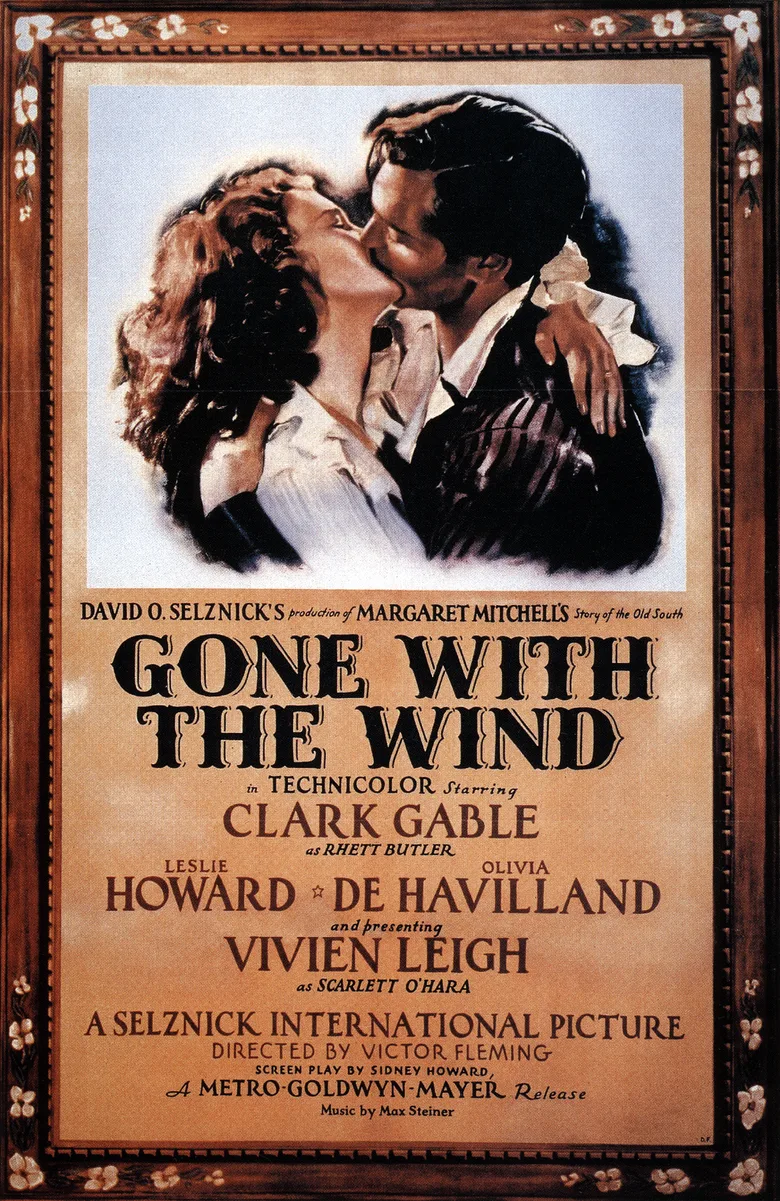
Gone with the Wind is a stupendous piece of image-making in the service of a historical fiction it never stops flattering, and both halves of that sentence have to be held at once.
Minor spoilers ahead
The Surfaces
Begin with what is actually on screen, because that is where the argument lives.
Three-strip Technicolor in 1939 was a substance, not a setting. It produced reds that behave like fabric rather than light — the drapes Scarlett tears down and wears, the crushed velvet, the dust turned amber by low sun. Ernest Haller and William Cameron Menzies built images that hold up as composition regardless of what one thinks of them: the silhouette against the burning sky, the pull-back over the wounded at the Atlanta depot until the frame cannot contain them and a torn flag enters the top of the shot. That crane move is one of the most effective things in American cinema. It is also doing something. It converts a military catastrophe into a spectacle of Southern suffering, and it is beautiful, and the beauty is the mechanism.
Vivien Leigh's face is the other substance. She is filmed in close-up more than anyone, and what registers is appetite — a hunger that the film keeps calling love and that is plainly something harder and more interesting. Her tempo is fast, interrupting, physical. She is never still. Two hundred and thirty-eight minutes is a long time to hold a picture on one performer's nervous energy, and she does it.
Hattie McDaniel is the other performance that survives everything. Watch the grain of her voice against the material she has been handed. She plays authority in a role written as service, and she does it by timing — the pauses she takes before answering, the flatness she puts on a line the script wants delivered warmly. She is acting against her own dialogue, in public, in 1939, and she is winning. She was not permitted to attend the Atlanta premiere of the film she was about to be awarded for.
The Tempo of a Lie
A film's pulse tells you what it wants. This one is languorous before the war and frantic after it, and the languor is where the trouble is. The first hour is a garden party — oaks, muslin, a barbecue, servants moving at the edge of frame like weather. Slavery is photographed as domestic staff. The camera does not show cruelty because the film has decided, at the level of image and rhythm, that this world was pleasant and was taken away.
I will not translate this into a position, because a film reduced to its politics has been avoided rather than examined. So: describe it. The lighting on the fields is golden. The music swells for the land. The people held there are in soft focus, in the middle distance, and their labour is never once filmed as labour. When the war ends, the picture's rage is reserved entirely for what has been lost by the people in the foreground. That is not an interpretation. It is a description of where the camera stands and how long it stays.
And it is enormously effective, which is the uncomfortable part and the reason the film is worth looking at rather than dismissing. Sontag's observation about beauty and bad politics applies exactly: the images are not less accomplished for being deployed in a fiction. They are more dangerous for it. A clumsy version of this film would be harmless.