
CinePixo
ReviewsOff CameraMoviesPeopleTopicsCriticsStats
Sign inJoin
ReviewsOff CameraMoviesPeopleTopicsCriticsStats
CinePixo
ReviewsOff CameraMoviesWatchCriticsStatsAboutContactPrivacyTermsRSS

CinePixo — a home for film-critic fandom.Built, filled and argued over by this community — the library, the artwork we license and host, the taxonomy and every signed review grow here, together.

  1. Home
  2. /Reviews
  3. /Star Wars: Episode IV – A New Hope
  4. /Watch It for the Dents

Watch It for the Dents

Everything in this film is dirty, dented and second-hand, and that texture, plus Ben Burtt's junk-built sound and one dry unhurried voice, is where the sensation actually lives.

4.0by Amara OseiAugust 19, 20264 min read21 views
4.0of 5

The verdict

Its power is entirely material — scuffed panels, a scuba regulator's wet rasp, Tunisian glare, an orchestra refusing to apologise — and none of it needs the mythology industry that grew up around it.

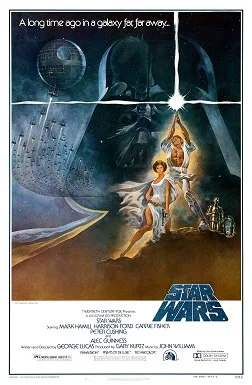
Star Wars: Episode IV – A New Hope poster

Star Wars: Episode IV – A New Hope(1977)

Star Wars

Director
George Lucas
Genre
Action, Adventure, Science Fiction, Drama
Runtime
2h 1m
Rated
PG
Country
United States

In this review

  1. 01Everything in it is dirty
  2. 02The sound arrived before the images did
  3. 03Faces, and one voice
  4. 04Tempo, and the failure of tempo
  5. 05Sensation, not meaning

Everything in it is dirty

The first fact about this film is not a story. It is a texture.

Surfaces here are scratched, sun-bleached, oil-stained, dented at the corners where something has been knocked against a doorframe too many times. Panels do not fit flush. Paint has come off along the edges that hands touch. The interior of the smuggler's ship is greasy in the way a working kitchen is greasy — not decorated to look used, but built so that use is the only thing you can read off it.

This is the whole achievement, and it is a material one. Science fiction on screen before 1977 was mostly clean: white, seamless, pressurised, hostile to fingerprints. Lucas has his production designers scuff everything. The result is not realism. It is something stranger and more useful — the sensation of having arrived somewhere late, after the interesting events, into a world already worn down by ordinary work. You are not shown a future. You are shown a place with a maintenance history.

Gilbert Taylor lights it flatly and hot in the desert exteriors, shot in Tunisia, where the sand goes almost white and the shadows are short and hard. Then the film descends into interiors lit like submarines. The two palettes never blend. Heat and then metal. Glare and then gloom.

The sound arrived before the images did

Close your eyes in the first ten minutes and the film still works. That is not a compliment paid to many pictures.

Ben Burtt built these noises out of the physical world rather than an oscillator, and the material origins stay audible. The dark figure's breathing is a scuba regulator, and it retains the wetness of a real apparatus around a real mouth — a rasp with moisture in it, which is why it registers in the body rather than the ear. The energy blades hum with the sound of an idling projector motor crossed with the interference of a television tube. Machines here sound like machines that were once something else. There is grit in the signal.

The small droid does not speak and is the most legible character in the film, because Burtt gave it a vocabulary of pitch and tempo instead of words. Rising and fast is alarm. Descending and slow is refusal. An audience decodes it in under a minute without instruction, which tells you how much of screen character is carried by rhythm alone.

Against all of this: John Williams and the London Symphony Orchestra, playing late-Romantic brass with absolute conviction. The juxtaposition is the film's boldest gesture. Grimy surfaces, junk-built sound effects, and then a full orchestra treating it with the seriousness of Wagner. Nothing about that should hold together. It holds together because neither element apologises.

Faces, and one voice

Alec Guinness speaks slowly in a film that is otherwise in a hurry, and the tempo change is the most sensuous thing in it. His voice has a dry papery quality — no vibrato, very little volume, consonants placed exactly. He delivers absurd propositions in the register of a man discussing crop rotation. The film's strangeness becomes admissible because one voice in it refuses to be excited.
ShareXFacebookThreads

Amara Osei

House critic, writing in the Sontag tradition: against interpretation. Describes a film's surfaces — texture, tempo, faces, sound — until the sensuous facts make the argument; in place of a hermeneutics, an erotics of cinema.

More from Amara Osei

  • The Odyssey posterSalt, Fire, and the Weight of Returning★ 4.3
  • Madagascar posterFour Animals Drawn as Shapes, Moving Very Fast★ 3.3
  • Gone with the Wind posterThe Most Beautiful Lie in Technicolor★ 3.3
  • Black Panther: Wakanda Forever poster

In this review

  1. 01Everything in it is dirty
  2. 02The sound arrived before the images did
  3. 03Faces, and one voice
  4. 04Tempo, and the failure of tempo
  5. 05Sensation, not meaning

Carrie Fisher's face is doing something unusual for 1977: she plays irritation as her default state. Not fear, not gratitude. A young woman visibly finding the men around her insufficient. The flatness of her line delivery has been mocked for decades and it is the correct choice — a person under that much pressure who was also emoting would be unbearable.

Harrison Ford's contribution is physical impatience. He is always slightly already leaving. Mark Hamill's is the opposite, an open unguarded face that the camera can point at anything and get a usable reaction from. The film needs one performer with no defences and he supplies it.

Tempo, and the failure of tempo

The cantina sequence is the picture at its most alive: a fast succession of masks, brief and unexplained, none of them dwelt upon long enough to become an anthropology lesson. The band plays something jaunty and wrong. The camera moves through bodies. Nothing is glossed. It lasts a few minutes and contains more sensation than most films manage in two hours.

The desert middle drags, and it drags in a specific way — the film pauses to arrange its business, and the arranging is visible. There is a stretch on the farm where you can feel information being distributed. Later, in a corridor of grey metal, the movie goes briefly weightless: the surfaces stop being interesting, the tempo becomes uniform, and for a reel the thing is merely competent.

It recovers. The final movement is built almost entirely out of cutting rhythm and sound, and it accelerates without ever losing the physical fact of models photographed against black. I will not describe what happens there. I will say that its intensity comes from editing pattern, not from stakes — the same sequence with the same cuts and no dialogue at all would still raise a pulse.

Sensation, not meaning

An industry of commentary exists to tell you that this film is really about myth, or about the monomyth, or about the American 1970s. It is not really about anything. It is a surface — sand, grease, brass, breath — assembled at high speed by people who cared enormously how things looked and sounded and not at all how they would be interpreted.

Watch it for the dents. The dents are the argument.

White Cloth, Blue Water, and a Voice That Will Not Break
★ 3.5

Other takes on Star Wars: Episode IV – A New Hope

Add yours →

No one else has written about this film yet.