Four Animals Drawn as Shapes, Moving Very Fast
The fur is styled into planes, the stripes work as rhythm, and a lemur with an accent from nowhere on earth sings a dance-floor hit into the middle of a children's film.
The verdict
DreamWorks made a picture that would rather be a poster than a photograph, and its pleasures are entirely graphic: velocity, saturated colour, and five voices with real grain.
An animated film owes reality nothing, and this one collects on the debt inside its first minute.
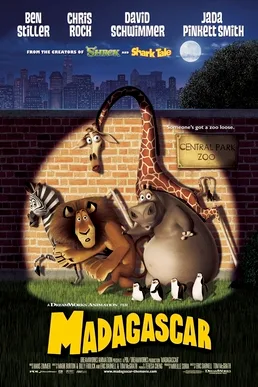
Look at the four bodies. Alex is a wedge — mane lacquered into planes, chest thrown forward, a lion assembled out of poster shapes rather than out of hairs. Marty is a set of stripes used as rhythm; the black bands do the work of motion lines even when he is standing still. Melman is a wobbling vertical, all knee and neck, drawn the way apprehension would draw itself. Gloria has mass, and the film is not embarrassed by it; she displaces the space she stands in. By 2005 DreamWorks could render convincing fur, and here declines to. The refusal is the picture.
Colour as appetite
The Central Park Zoo is lit like a stage set: deep greens against night blues, footlights turned on a captive audience that has paid to look at captives. Then the palette changes hands. Turquoise water, sand the colour of a cheap paperback, foliage in greens turned up past anything botanical. The island does not look researched. It looks mixed, the way gouache gets mixed — pigment chosen because it is pleasurable next to the pigment beside it.
Eighty-six minutes, and almost none of them at rest. The cutting is quick, the staging is broad and frontal, gags are built and paid off inside four or five shots. This is comic tempo as a physical property, closer to a cartoon short strung end to end than to the three-act architecture the running time implies. When it slackens, it slackens in the middle of the island, where the film has to arrange people rather than move them.
The grain of five voices
Ben Stiller pitches Alex slightly too large for the room — showbiz projection, a performer performing a performer. Chris Rock keeps Marty in his upper register and at speed, consonants clipped, so that the zebra sounds like impatience itself. David Schwimmer gives Melman a thin apologetic tenor that cracks upward. Jada Pinkett Smith is the only voice at rest: level, warm, unhurried, and the film uses her as ballast.
Then Sacha Baron Cohen arrives speaking an accent assembled from nowhere on earth and sings a cover of "I Like to Move It" — a piece of dance-floor pop grafted whole into a children's film, unembarrassed, and the tempo of everything after it changes. Hans Zimmer's score keeps pace without ever leading; it is scored to catch up with the images, which is the correct decision here and a rarer one than it sounds.
What the surface will and will not do
There is a place, past the first act, where the film discovers that hunger is a physical fact and not a joke, and for a few minutes the drawing tightens: eyes narrow, colour drains toward red, the comedy holds its breath. I will not describe what happens. I will say that the picture is more interesting in those minutes than in any of its set pieces, and that it does not stay there — it cannot, and knows it cannot, and gets out with a shrug.