White Cloth, Blue Water, and a Voice That Will Not Break
Describe the surfaces and the film gives itself away: cloth, dust, water, and the grain of Angela Bassett's voice doing what the script cannot.
The verdict
Wakanda Forever is most alive in its textures and its silences, and thinnest whenever it remembers it is also a franchise with obligations.
Surfaces First
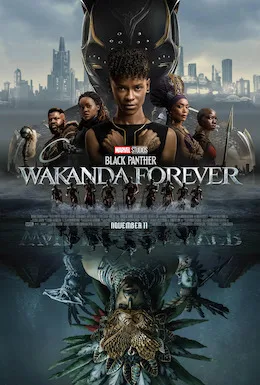
Begin with the white. Wakandan mourning is filmed as fabric — loose, bright, moving in air — and the film's first passage lets that whiteness occupy the screen without an argument attached. Dust rises. Voices are raised in a register that has nothing to do with dialogue. For several minutes the picture is a procession of textures: cloth against skin, skin against sunlight, the percussive shuffle of many feet on packed earth. Ludwig Göransson withholds the orchestral bloom one expects and lets drums and voice carry it instead.
This is the film at its most confident, and it is confident because it is not explaining. Grief here is a matter of tempo. The camera moves at the speed of people who have somewhere to be but no reason to hurry. Autumn Durald Arkapaw's photography keeps the whites hot and the shadows warm, and the images have a weight of daylight in them that Marvel pictures usually sand away.
Then there is the blue. Talokan is lit as a place with no sun, which sounds obvious and is in fact rare — the sequences are genuinely dim, blue-black, legible more by silhouette than by feature. The design refuses the Atlantean vocabulary entirely: this is stone and jade and feathered relief, an architecture with a different history in it. Tenoch Huerta's Namor is photographed as skin and stillness. He speaks quietly, and the quiet is the effect.
Tempo, and the Cost of Obligation
A film's pulse tells the truth about it. This one has two pulses and they do not synchronise. The mourning passages are slow, tactile, unhurried. The plot passages are brisk, geographically restless, and full of rooms where people stand and describe intentions. Every time the picture returns to Wakanda's council chamber the temperature drops — not because the actors fail, but because the scenes exist to advance an apparatus.
Angela Bassett is what holds the two pulses together, and she does it with her voice. Not with lines: with grain. There is a scrape in it, a control held one degree short of breaking, and the camera is wise enough to sit still and let it be heard. She is doing something older than this genre. When she is on screen the film has a floor under it.
Letitia Wright's Shuri carries the other half and carries it differently — inward, clipped, physically smaller than before. The performance is at its best in the laboratory, hands busy, face refusing to arrange itself. It is weakest when the script hands her a thesis to state aloud. The introduction of Riri Williams brings genuine energy and a tonal seam: her scenes have the tempo of a different film, faster and funnier, and the picture never quite decides whether to slow her down or speed itself up.
What Stays
One hundred and sixty-one minutes is a long time, and the length is not the problem. The problem is that two of those hours are made of sensuous fact and the rest is made of arrangement. The action, when it consolidates at sea, is staged with clarity but photographed like a different picture — flatter, brighter, less interested in surface. Water, which the film has treated as a substance with mass and darkness, becomes a location.