Gravity With Dust Under Its Nails
Its grandeur is not in the stars alone, but in the scraped tables, cracked fields, and human voices strained by distance.
The verdict
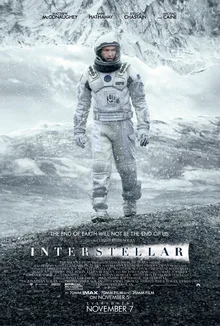
Christopher Nolan’s Interstellar is a magnificent, uneven machine: most alive when it lets dust, silence, organ thunder, and weathered faces do the thinking.
Dust Before Cosmos
Interstellar begins not with the infinite but with residue. Dust lies on bookshelves, coats furniture, enters lungs, writes itself across domestic space. The early passages have the strange dignity of a disaster that has become ordinary. Cornfields stand where ambition has been forced downward into soil. Trucks rattle over dry roads. A baseball game is interrupted by a wall of weather. Nolan is often accused of chilliness, but here he understands abrasion. The future is not chrome. It is a farmhouse with grit in its corners.
Matthew McConaughey’s Cooper is most convincing before he becomes an astronaut again. His face carries impatience like a weather system. The voice, with its rasp and warmth, seems always to be arguing with gravity. He is a man whose body remembers speed while his life has been narrowed to harvests, parent-teacher meetings, and repairs. Mackenzie Foy’s Murph has a startling watchfulness. She looks at adults as if language itself were a defective instrument.
The first act is Nolan at his strongest because the images still resist diagramming. A bedroom, a field, a drone, a secret facility: these are not clues to be decoded but surfaces charged by pressure. The film’s best emotion comes from objects that do not plead. A watch. A pickup truck. A line of crops bending under wind. Seriousness here is not solemnity. It has dirt on it.
The Cathedral Engine
Once the film leaves Earth, it becomes an instrument of scale. The spacecraft interiors are narrow, practical, almost ugly; their modesty makes the exterior immensities more severe. Space is not a velvet poster but an absence with edges. The wormhole appears as a sphere, a visual idea simple enough to feel ceremonial. The black hole Gargantua, ringed with distorted light, remains one of modern cinema’s great sights: terrifying because it is beautiful without asking permission.
Hans Zimmer’s score is both miracle and hazard. The organ does not accompany the images; it invades them. It makes space feel ecclesiastical, not because anyone explains it that way, but because the sound has height, pressure, and breath. At its finest, the music turns duration into force. At its worst, it tells the viewer to kneel. Nolan too often distrusts quiet after discovering it. Yet the quiet in Interstellar is extraordinary when allowed to live: the small mechanical sounds, the thin voices over comms, the hard cut from catastrophe to vacuum.
The film has tempo trouble because it wants both awe and instruction. It races when it should stare. It lectures when it has already shown enough. Scientific exposition arrives in blocks, sometimes elegant, sometimes deadening. Nolan’s cinema loves rules: time ratios, docking procedures, equations, mission parameters. The danger is not complexity. The danger is that explanation can sand away sensation. Still, the film repeatedly wins back the body. A wave rising like a moving horizon. A spin in silence. A gloved hand against machinery. The pulse returns.