A Door Opens, and the Room Gets Bigger
I remember the strange pleasure of watching a blockbuster trust both the audience’s pulse and its curiosity.
The verdict
The Matrix is a thrilling action picture that keeps its genre promise and then, almost casually, expands the size of the moviegoing room.
The Smile Before the Fall
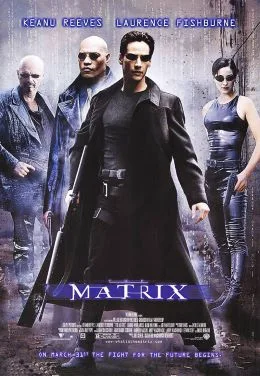
There is a particular moviegoing joy in realizing, about twenty minutes in, that the film is not bluffing. The Matrix begins in leather, night rain, computer screens, phone booths, and rooms lit as if the bulbs have bad news. It could have been all attitude. Instead, Lilly and Lana Wachowski build a machine that runs on doubt. Every surface seems to be asking the same question: what if the world you have accepted is only the waiting room?
Keanu Reeves plays Neo with a quality that has sometimes been mistaken for blankness, but here it is exactly right. He looks like a man whose soul is buffering. There is a lovely uncertainty in his face, a half-second lag between hearing something impossible and deciding whether to believe it. That is not a small thing in a movie like this. If the hero is too clever, the wonder dies. If he is too foolish, the audience gets ahead of him. Reeves gives us a man who is bright, lonely, tired, and just vain enough to hope the mystery is about him.
Laurence Fishburne enters as Morpheus with the calm of a preacher who has already seen the promised land and the patience of a teacher who knows the student may run out the door. His voice is a velvet rope. Carrie-Anne Moss, as Trinity, has one of the great first impressions in modern action films: she does not explain cool, she inhabits it. Watch her face when she studies Neo. She is measuring not only whether he is useful, but whether he can survive the truth. Hugo Weaving, meanwhile, gives Agent Smith the dry disgust of a bureaucrat who has come to hate the smell of the office.
Bodies in a New Grammar
The famous action still works because it is not merely decoration. Yes, there are the black coats, the sunglasses, the impossible bends of the body, the gunmetal ballet of the lobby and the clean shock of slowed time. But what matters is that the style expresses the premise. The fights are not pauses in the story. They are arguments about what reality permits.
I have seen movies imitate the surfaces of The Matrix for years, usually with the tragic belief that a long coat is a philosophy. The Wachowskis understood the old rule: show me something I have not seen, but make me understand why I am seeing it. The wire work and visual effects have the boldness of comic books and kung fu pictures, and the editing gives the audience the courtesy of knowing where bodies are in space. You can feel the hits. You can also feel the thought behind them.
The rooms are important. Neo’s apartment looks like a place where sleep has lost a long argument. The office cubicles have the spiritual temperature of a refrigerator. The ship interiors later have the worn, practical look of people who cannot afford beauty but still need each other. This is where the film’s empathy sneaks in. It is not simply about waking from an illusion. It is about the ache of discovering that comfort and captivity can share the same wallpaper.