Desire in the Space Between Two Doorways
Wong Kar-wai does not preserve an elegant romance under glass. He crowds it with neighbors, clocks, rain, noodle runs and two stars whose smallest movements make good behavior feel dangerous.
The verdict
In the Mood for Love turns restraint into a physical sensation: every hallway is too narrow, every song returns too soon, and every glance arrives carrying the touch the film withholds.
The walls are in on it
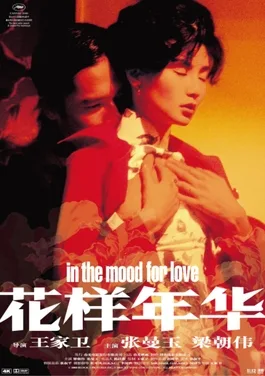
People talk about In the Mood for Love as if it were a porcelain object: exquisite, untouchable, the respectable movie you put on a shelf after praising the dresses. That makes it sound dead. Wong Kar-wai's film is feverish. It sweats through its collars. It sends Mrs. Chan and Mr. Chow down the same cramped staircase for noodles, again and again, until repetition becomes contact. The walls squeeze them together while manners insist on distance. You feel the contradiction in your shoulders.
Maggie Cheung does more with the angle of her neck than most actors manage with a confession. Her cheongsams are famous, and rightly so, but they are not museum pieces. Their high collars and exact seams make composure visible as work. Tony Leung Chiu-wai answers with stillness of his own, a face that seems relaxed until the eyes reveal how much calculation is going into the calm. When the two discover that their spouses are having an affair, the movie refuses the easy release of outrage. They begin rehearsing how it might have happened. A question becomes a scene; a scene becomes an intimacy neither of them can safely name.
The boarding house is full of people, food and noise. Privacy has to be stolen in fragments. A neighbor can appear at any moment. A landlady can turn a casual question into surveillance. Wong shoots through doorframes, around corners and past foreground objects, making us feel both like confidants and eavesdroppers. The romance does not bloom despite the social world. It takes its shape from the pressure of being watched.
Repetition with a pulse
That Nat King Cole song returns, and returns, and returns. In a lesser picture the repetition would underline an emotion already delivered by the actors. Here it changes time. The same walk down a corridor is not the same walk once desire has been admitted to the room. Slow motion lets fabric, cigarette smoke and a passing shoulder acquire weight without pretending that any of them is a symbol in a lecture. The film knows that wanting someone makes ordinary objects insolent. A wall is suddenly too close. A clock is suddenly personal.
Wong was making the picture without a conventional fixed script, and the finished film retains the nervous freedom of discovery while looking obsessively controlled. That combination is its kick. The compositions trap the characters, but the performances keep threatening to escape them. Cheung can turn a pause into accusation, then soften it before the other person can answer. Leung's smile arrives as a defense and leaves as a wound. Their scenes do not climb toward one grand declaration. They circle, retreat and try again.
I laughed more than the film's reputation had prepared me to. The role-playing has a dry awkwardness; the neighbors possess the comic terror of people who are always available when you need them least. That humor prevents the longing from becoming perfumed misery. These are adults trying to remain decent and discovering that decency can hurt other people too, especially themselves.