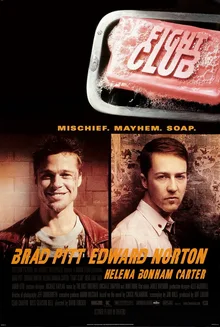
Soap, Insomnia, and the Best Bad Idea of 1999
Everyone still fights about what it means. Nobody fights about how it feels, which is like being cornered at a party by the funniest, drunkest, most dangerous person there.
The verdict
Fight Club has the philosophy of a clever sophomore and the filmmaking of a man at the absolute top of his powers, and the filmmaking wins the argument by about forty minutes.
Minor spoilers ahead
The Funniest Movie Ever Made About Furniture
Here is the part nobody puts on the poster: for its first forty minutes, Fight Club is a comedy. Not a dark comedy, not a satire in the term-paper sense — a joke machine about a man who cannot sleep and has decided the problem is his sofa. Edward Norton narrates in a flat, helpful, customer-service voice, the voice of a person reading you your own warranty. David Fincher films the condo as a catalogue that has come to life, the prices floating in the air next to the furniture, and it is such a good gag that a lesser picture would have built a whole third act out of it. This one throws it away in ninety seconds and moves on. That tells you what kind of movie you are in. It is rich. It can afford to waste things.
Then the support groups. Diseases he does not have, strangers who hold him while he cries, and Meat Loaf — Meat Loaf! — as a wrecked, kind man with no defenses left, giving the film its one completely sincere embrace. The joke is cruel and the scene is not, and that combination is harder to pull off than anything in the back half. Helena Bonham Carter turns up smoking like it is a career, playing the only character in the picture who has done the reading and declined to be impressed. And then Brad Pitt walks on with a suitcase full of certainty.
Tyler, Sold Separately
Pitt is having the time of his life and he is not subtle about it. He does not play Tyler Durden as a devil or a prophet; he plays him as the best-looking guy in the room who has noticed that nobody ever says no to the best-looking guy in the room. The lines land because he delivers them like a waiter reciting specials — pleasant, bored, absolutely certain you will order. Half of what he says is nonsense. You will still repeat it in the car afterwards. That is not a failure of the movie. That is the movie's actual subject, and it is smarter about it than its fans have ever been.
And it moves. Jeff Cronenweth shoots the whole thing in a palette of copper, bile and wet asphalt, and Fincher cuts to the Dust Brothers' skittering drum loops, so even scenes of two men talking in a filthy kitchen have a pulse. The picture is 139 minutes long and I never once looked at the door. When it does go for basement violence, it is not exciting. It is a wet, close, badly lit thing that looks like it hurts to lose and hurts more to win — which is the correct choice, and one very few movies of the era were brave enough to make.
The section where the film explains its own tricks — projection booths, splices, the marks in the corner of the frame — is the giveaway. Fincher is telling you, right there, that you are watching something assembled by a person who wants control of your nervous system. He earns the boast. There is a monologue about recall campaigns and the arithmetic of a human life, delivered in that same helpful voice at 30,000 feet, and it is the coldest thing in the picture.