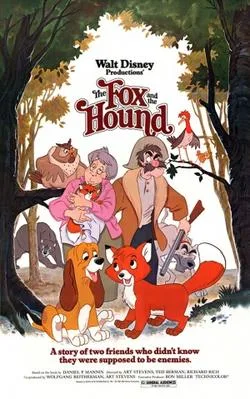
The Nicest Cruel Movie Disney Ever Made
You go in for a cute fox and a cute puppy. You come out remembering how quietly the picture tells you that what they are will beat what they feel.
The verdict
It arrives dressed as a nursery picture and it is really about instinct outranking affection, and the astonishing thing is that Disney in 1981 does not blink.
Twenty minutes in, this movie hands you exactly what you came for: two babies at play, an owl singing "Best of Friends" over the top of them, a widow's farmhouse in autumn light. It is soft. It is competent. You settle in for eighty-three minutes of nothing much.
Then it starts telling you what it actually knows, which is that a fox and a hound do not get to decide what they are.
The cute is the setup
The film opens without a word: a vixen running with a kit in her mouth, setting him down, and a gunshot somewhere off the frame. That is the first two minutes. Everything sweet that follows — Big Mama steering the orphan toward Widow Tweed, Pearl Bailey doing vaudeville warmth from a branch, the songs arriving exactly on schedule like a studio memo being satisfied — sits on top of that gunshot.
And the hunter next door is not a villain with a plan. Amos Slade is a man with dogs and a season. Jack Albertson plays him cranky rather than wicked, which is worse, because you cannot hate him properly and the movie will not help you try. Chief is a working animal who resents a puppy. Nobody here wants the ending they are all walking toward, and nobody stops walking. That is a real idea, and Disney in this period was not supposed to have one.
Where it goes slack
The back half stops to sing, and the picture goes quiet in the wrong way — a courtship interlude, pleasant, weightless, fifteen minutes I would trade for five more of two friends failing to be friends. You can feel the machinery: a musical number owed to the format, delivered, banked.
The voices split the same way. Mickey Rooney gives the grown Tod a showbiz rasp that never quite settles into an animal; you keep hearing a man in a booth. Kurt Russell is plainer and better — decency with a job to do, which is precisely the trap Copper is in. Sandy Duncan is charming and has almost nothing to play. The children who voice the pups get the best material in the film and hand it over halfway through, and the trade is not free.
Then the last stretch wakes up and goes straight for your throat. I am not going to say how. I will say that I stopped taking notes.
Hand-me-down animation with a pulse
This is the last picture the studio's old guard worked on before retiring, made while a group of younger animators walked out the door mid-production, and you can see the seams. The xeroxed line is scratchy and grey. Backgrounds are thinner than anything from the studio's confident years — some forests are two planes and a wash. The autumn palette is the one thing that carries: rust, ochre, wet slate, a whole picture the colour of the end of something.
But it moves. There is real weight in the animals — a hound's shoulders working under loose skin, a fox's spine going low and quick — and weight is the thing polish cannot fake. Given a choice between a smooth film with nothing at stake and a scruffy one that means it, I will take the scruff every time, and this is the scruff.