Ajmal Sabu Keeps Bethlehem Kudumba Unit’s Camera Close, Then Cuts Away
In a Cinema Express interview published September 9, the cinematographer-editor explains how tighter lenses, mapped daylight and footage from trains, highways and sets built Bethlehem Kudumba Unit’s visual grammar. The film’s result is unseen here; what follows is a report of Sabu’s stated methods and the responses published by other outlets.

Ajmal Sabu says he does not think of his work on Bethlehem Kudumba Unit as a choice between editing and cinematography. In an interview with Cinema Express on September 9, the film’s director of photography said he has always edited alongside camera work, from trailers and music videos to features. He is now cutting Suriya and Jithu Madhavan’s Scene in Chennai while Bethlehem Kudumba Unit continues its theatrical run after opening on August 21, 2026.
That overlap matters because Sabu describes the camera in terms of duration and connection. He thinks about how long a shot must last, how it should move into the next one, and how to avoid leaving an editor with unusable material. The film’s reported visual design therefore begins before the edit: in lens choice, camera distance and the amount of footage gathered at each location.
Ajmal Sabu redraws the frame after Premalu
Cinema Express reports that Sabu and Girish AD approached Bethlehem Kudumba Unit as a larger spatial problem than Premalu. The earlier film, Sabu said, used handheld and wide-lens shots close to its teenage characters in an urban setting. The new film contains more people, houses and a whole locality, so the first task was to make its geography legible.
For the opening 20 to 30 minutes, the team wanted viewers to understand where houses stood, how spaces connected and who belonged to each part of the neighbourhood. Sabu also tracked sunrise and sunset at every location, seeking at least one usable natural-light shot each day. To hold the larger world together, he added tighter lenses to the wides.
That change has a physical consequence. A wide lens can place bodies inside a network of rooms, lanes and neighbours; a longer lens separates a face from that network and gives it weight. Cinema Express says Sabu used lenses around 85mm to 100mm for the close-ups of Nivin Pauly, while Mamitha Baiju’s expressions were allowed to carry the frame without visual distraction.
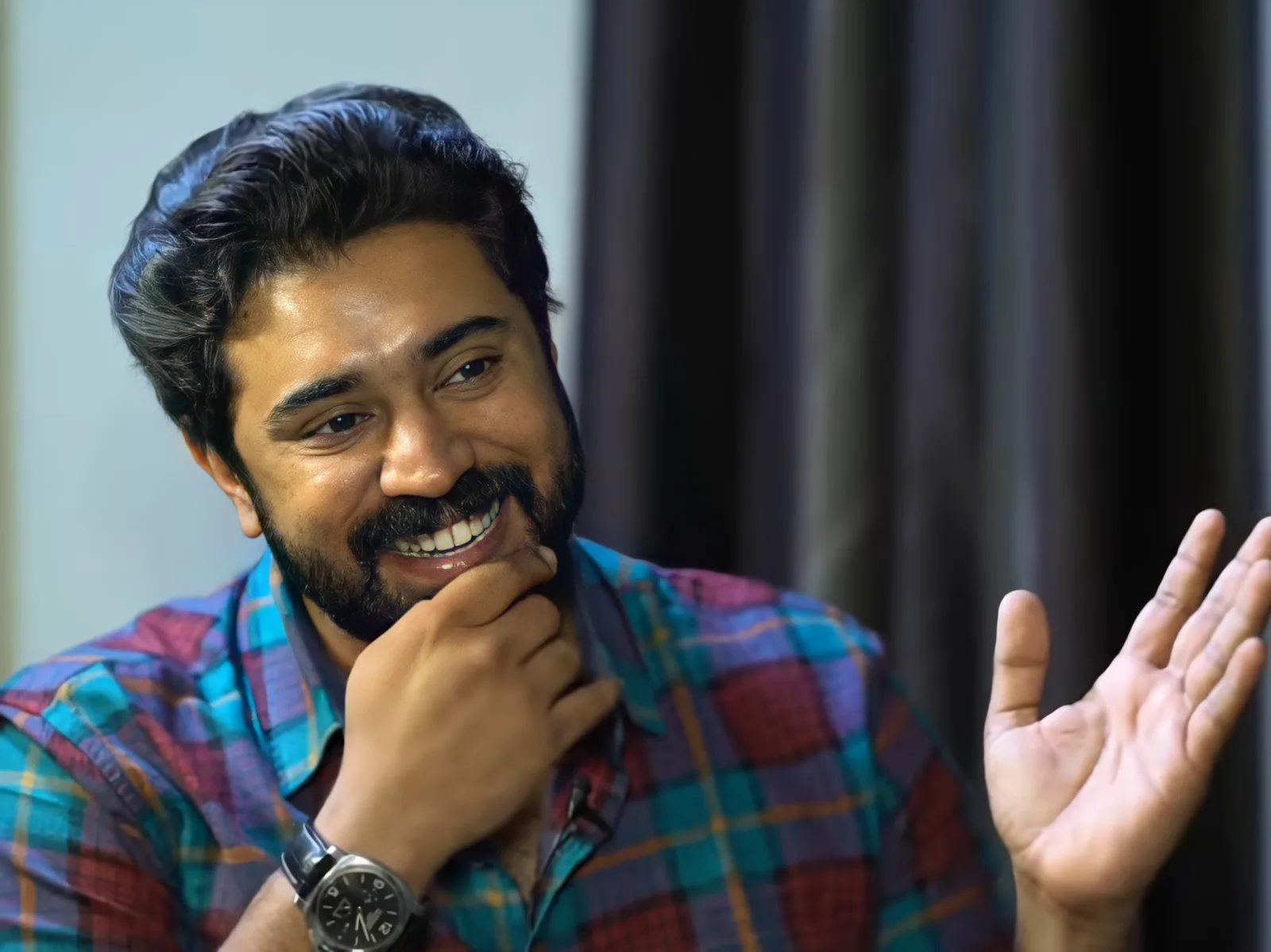
Photo: Nivin Times · CC BY-SA 4.0 · source
Rain, green and the limits of real locations
Sabu told Cinema Express that the film begins and ends with rain, so the wet quality had to persist between those points. The colour plan used dark olive green, navy blue and maroon, with lemon and pastel yellow as lighter notes. Green entered through costumes as well as lighting.